
In the next 60 minutes, I’m going to take you from zero German to being able to form real sentences at the A1 level. Sounds crazy, right? Trust me it’s doable. I know, German has this scary reputation. With those super-long words like Rindfleischetikettierungsüberwachungsaufgabenübertragungsgesetz yes, that’s a real word and all those grammar rules, it can feel like a mountain to climb. But here’s the truth: you don’t need to be perfect to start speaking. If you just focus on the basics the most common words, a few simple grammar rules, and forming sentence patterns you’ll already be way ahead. It’s not about learning everything, but learning smart. And that’s exactly what we’re going to do in the next few minutes.
Now, I’m not a native German speaker, and this isn’t meant to replace a proper German course but I’ve done my homework on this. I’ve researched, learned, and figured out what actually works. And by the end, I promise you’ll be able to introduce yourself and speak simple, clear sentences in German. Let’s get started.
The German Alphabet and Pronunciation

Let’s start with the absolute basics the building blocks of any language the letters. Now, here’s something you need to watch out for. German uses the same 26 letters as English, but that doesn’t mean they sound the same. Most of them are pretty similar, but a few can really surprise you.
So, let’s go over the regular alphabet first. Please repeat after me slowly:
A, B, C, D, E, F, G, H, I, J, K, L, M, N, O, P, Q, R, S, T, U, V, W, X, Y, Z.
But it doesn’t stop there. There are four extra characters ä, ö, ü, these are called Umlaute, and ß, called Eszett or the “sharp S”.
ä sounds like the “e” in “bed.” For example: Mädchen → kind of like “MED-shen.” Repeat after this. [Play].
ö sounds like the “i” in “bird” or “u” in “burn,” but with rounded lips. schön → sounds a bit like “shurn” (but with round lips). schön. Repeat after this.[Play]
And ü is like the “ee” in “see,” but with rounded lips. For example, über → kind of like “ew-ber” (but with tighter lips). Repeat after this. [Play]
And the ß — that’s basically a double “s” sound. Exactly like “ss” in English like in “kiss” or “hiss.” You can even replace it with “ss” when writing if needed. For example, Straße → sounds like “STRAH-suh,” which means street. Repeat after this. [Play]
Nice! You’re doing great so far. You know what? Since you’re absolutely killing it, let’s skip all the boring grammar stuff for now and jump straight into the speaking part.
Basic Greetings
Let’s learn how to greet someone, and let’s start with the most common greeting.
Hallo! You know what it is. But if you look closely, it’s with an “a,” not an “e,” and if you remember, a is “aa” in German, so that’s how it’s pronounced too — Hallo.
Now, if it’s morning, we add a little extra to our Hallo and say Guten Morgen! or Good morning!

If it’s evening, it becomes Guten Abend! Good evening!
And during the day, you can use Guten Tag! which means “Good day” or “Good afternoon.”

Now, when it’s time to say goodbye, you say Auf Wiedersehen! which literally means “until we see each other again.” That’s the more formal way to say goodbye. But if you’re in a hurry, you can simply say Tschüss or “Bye!”.
But life’s not that simple, right? We can’t just say “Hallo” and walk away every time. At some point, you’ll want to say a few more words maybe introduce yourself or ask something. And for that, we need to understand how sentences are actually made in German.
And just like in English, most German sentences are built around three main parts: a subject, a verb, and an object. In most beginner sentences, the subject and object are usually just nouns or pronouns. So let’s start with them.
Noun Genders and Articles
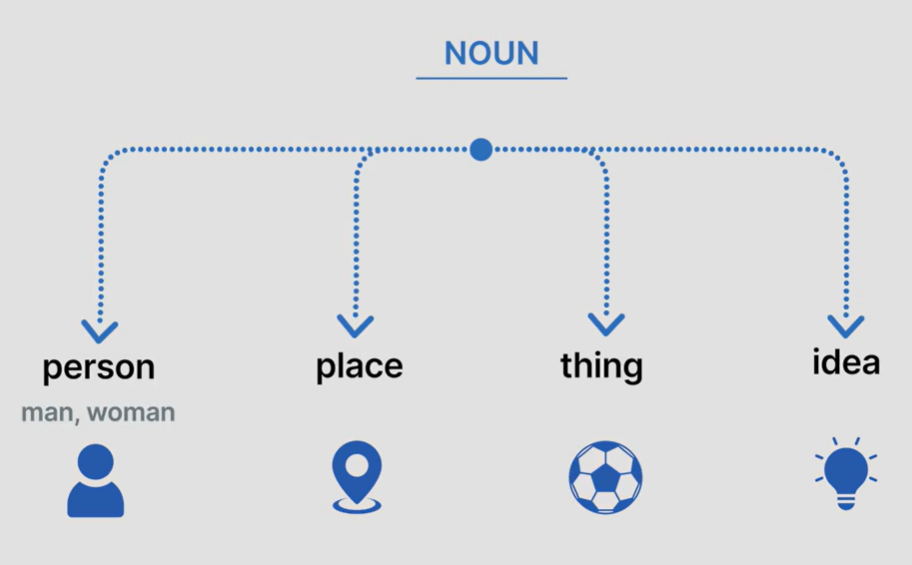
In simple terms, a noun is just a word that represents a person, place, thing, or even an idea like “man,” “woman,” “city,” “dog,” or “happiness.”
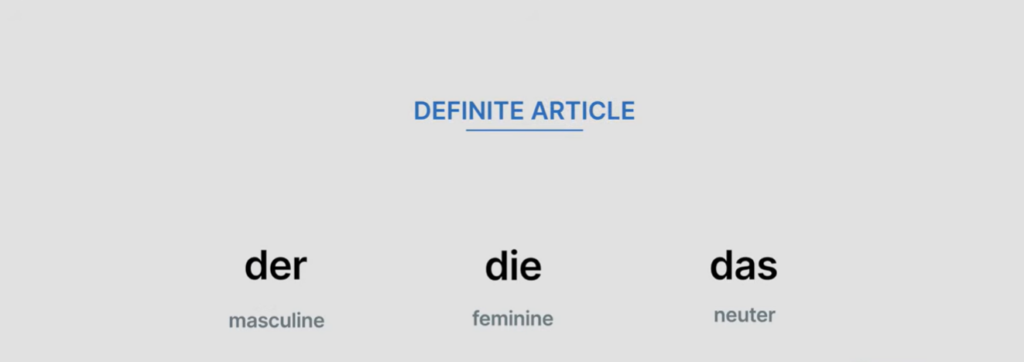
In German, it’s the same concept… but there’s one big twist: every noun has a gender. And it’s not just for people or animals even objects like a table or the sun have genders. And there are three in total masculine, feminine, and neuter- and every noun comes with an article that represents the gender.
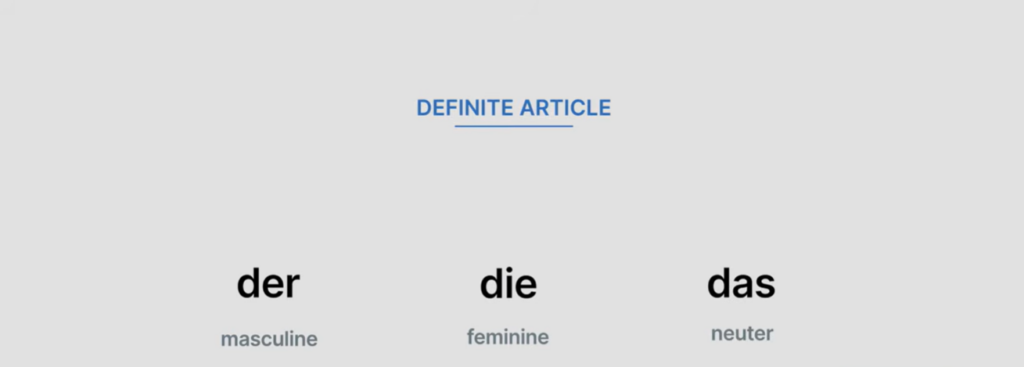
So we have:
der for masculine,
die for feminine,
and das for neuter.
For example:
der Mann – the man (masculine)
die Frau – the woman (feminine)
das Kind – the child (neuter)
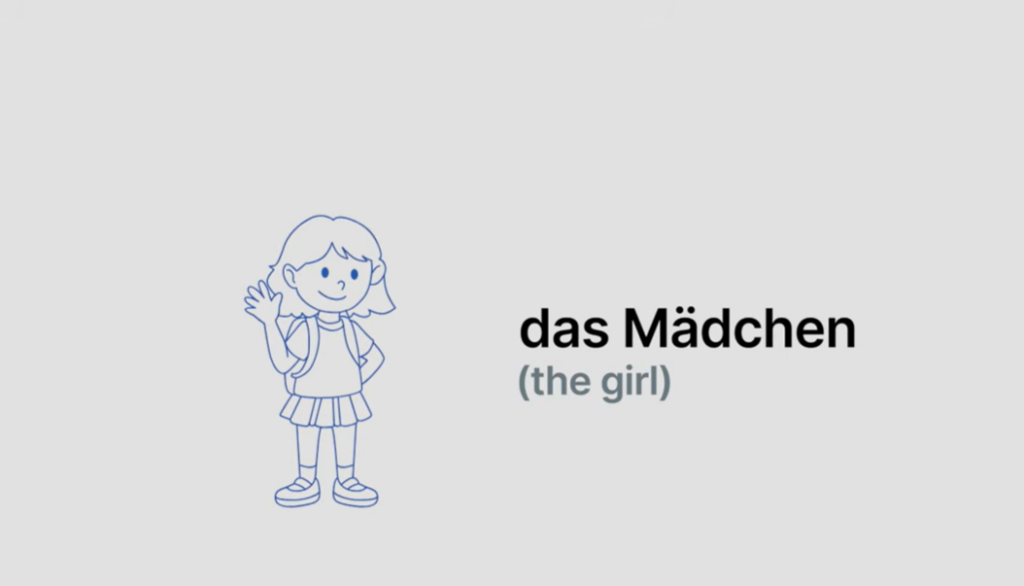
Now, here’s where things get a little tricky. The gender need not always be what you expect. For example, “girl” is das Mädchen and yep, it’s neuter, not feminine. Or take die Sonne (the sun), which is feminine, and der Mond (the moon), which is masculine.
I know — it doesn’t always make sense. So the best way to handle this is to always learn the noun with its article and memorize them as one unit. For example, don’t just learn Haus (house); learn das Haus.
It’s not easy at first, but don’t worry — I have something that’ll make this part way easier for you. I’ll share that towards the end.
But when it comes to the plural form, there is a slight relief. In plural form, the article stays the same die. So it’s die Männer (the men), die Frauen (the women), and die Kinder (the children). But you’ll notice something here: the noun itself changes in the plural form. Again, there’s no single rule for this. Sometimes you add -e, sometimes -en, sometimes -er, and other times, even the vowel inside the word changes.
For example:
der Tisch (the table) → die Tische (the tables)
die Frau (the woman) becomes die Frauen (the women)
das Kind (the child) → die Kinder (the children)
das Buch (the book) becomes die Bücher (the books)
So just like with the article, it’s best to learn the plural form together with the noun, case by case, word by word. That’s the easiest way to get it in your head.
The final important thing you should know about nouns is that in German, all nouns are capitalized, no matter where they appear in a sentence. So, for example, “the book” in German is written as das Buch with a capital B*.* This is one of those little details that make German text look different from English.
German Personal Pronouns (Subject Pronouns)
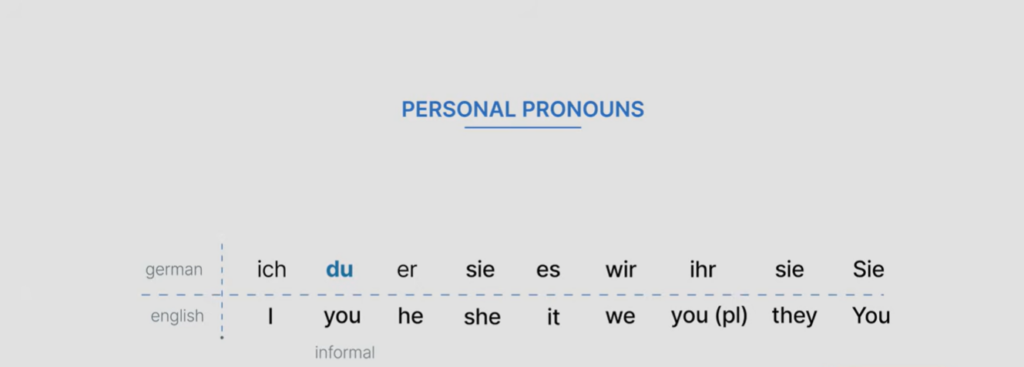
Personal pronouns are words we use to talk about people or things without naming them directly, like I, you, he, she, or it in English. And of course, German has them too. In the basic form, Personal pronouns in German are
ich – I
du – you (the informal singular version)
er – he
sie – she
es – it
wir – we
ihr – you (informal plural version, like in “you all”)
sie – they
Sie – you (formal, which is used for both singular and plural)
There are two things to take note of here. One, there are actually two ways to say “you”: du and Sie. Du is the informal version — you use it with friends, family, or people your age. Sie, on the other hand, is formal — you use it with strangers, older people, or in professional situations to show respect or politeness.
And the second thing to know is about the multiple meanings of the word “sie.” It can mean “she,” it can also mean “they,” and when written with a capital S — Sie — it means the formal “you.”
For example:
- sie ist nett → “she is nice”
- sie sind nett → “they are nice”
- Sind Sie nett? → “Are you nice?” (formal “you”)
In spoken German, they sound exactly the same — but in writing, that capital S makes all the difference.
Now, let’s talk about the connecting bridge between the subject and the object — the verb.
Verbs
Verbs are the action words — they tell us what’s happening or what someone’s doing. Those are words like “eat”, “run”, and “learn.
In German, the infinitive form of a verb is basically the base form, like saying to eat, to run, or to learn in English. Almost all infinitive verbs in German end with “-en” or sometimes just “-n.” So in German, that would be essen, laufen, and lernen.
So, we’ve already learned about the basic sentence structure subject, verb, and object and we’ve also talked about nouns, pronouns, and verbs. Now, let’s put all of that together and start forming some simple sentences.
Form Sentences
Let’s take an example I am learning German, or in German, Ich lerne Deutsch. Here, Ich is the subject (I), which is a pronoun, lerne is the verb (am learning), and Deutsch is the object (German). The structure is almost the same as in English Subject–Verb–Object.
But here’s something interesting even though the base verb is lernen, we didn’t say Ich lernen Deutsch. We said Ich lerne Deutsch. Why? Because in German, the verb form changes depending on the subject. So even if in English we say, “I learn,” “you learn,” and “we learn”, they all use slightly different endings in German. This is what’s called verb conjugation.
And there is a method to find the correct conjugated form of the verb. You start with the infinitive form, which usually ends in -en or -n, like lernen. Then, remove -en to get the verb stem or “lern”, and add different endings to this stem depending on who is doing the action.
Now let’s check this with an example. You can repeat after me.
Ich lerne Deutsch – I am learning German
Du lernst Deutsch – You are learning German.
Er lernt Deutsch – He is learning German.
Sie lernt Deutsch – She is learning German.
Es lernt Deutsch – It is learning German.
Wir lernen Deutsch – We are learning German.
Ihr lernt Deutsch – You all are learning German.
Sie lernen Deutsch – They are learning German.
Sie lernen Deutsch – You (formal) are learning German.
You can apply this pattern to most regular verbs. For example:
machen (to do/make) → ich mache, du machst, er macht, wir machen, ihr macht, sie/Sie machen. But there are also verbs that change their vowel addtionally in the du and er/sie/es forms like sprechen (to speak): ich spreche, du sprichst, er spricht, wir sprechen, ihr sprecht, sie sprechen.
And finally, there are some verbs that don’t follow this rule at all. Two of the most important such verbs that you’ll use all the time are sein (to be) and haben (to have).
Here’s how they go:
sein (to be): ich bin, du bist, er/sie/es ist, wir sind, ihr seid, sie/Sie sind.
haben (to have): ich habe, du hast, er/sie/es hat, wir haben, ihr habt, sie/Sie haben.
Now, let’s look at some simple examples:
Ich bin Student. – I am a student.
Du bist Student. – You are a student.
Er ist Student. – He is a student.
Sie ist Studentin. – She is a student.
Es ist Student. – It is a student.
Wir sind Studenten. – We are students.
Ihr seid Studenten. – You all are students.
Sie sind Studenten. – They are students.
Sie sind Student. – You (formal) are a student.
Similarly,
Ich habe ein Auto. – I have a car.
Du hast ein Auto. – You have a car.
Er hat ein Auto. – He has a car.
Sie hat ein Auto. – She has a car.
Es hat ein Auto. – It has a car.
Wir haben ein Auto. – We have a car.
Ihr habt ein Auto. – You all have a car.
Sie haben ein Auto. – They have a car.
Sie haben ein Auto. – You (formal) have a car.
Hope you get the idea.
Introduction
Alright, we’ve learned enough to move a little further from just saying Hallo. Now, let’s actually address people and introduce ourselves in German. This is where things start getting fun!
To introduce yourself, you can say:
“Ich heiße Srijith.” – “I am called Srijith.”, the verb is heißen
Or you can also say,
“Mein Name ist Srijith.” – “My name is Srijith.”
Again, notice the same structure Subject, Verb, Object..
Now, in a normal conversation, the next step would be to ask the other person’s name. And to do that, we need to learn how to ask questions in German.
W-Questions (Information Questions)
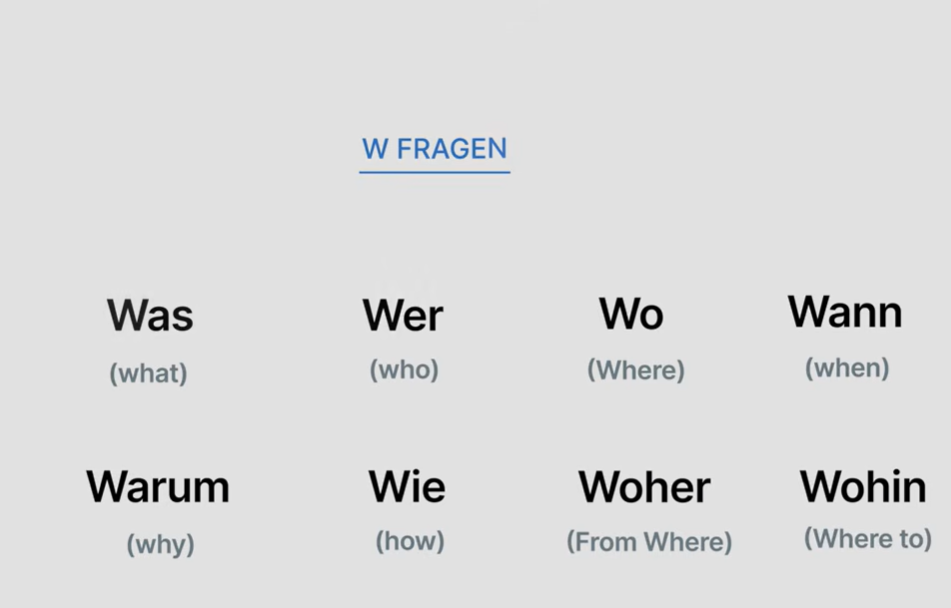
Sentences used to ask questions in Germany mostly begin with “W”, so they’re often called W-Fragen or W-questions. The common ones are Was (what), Wer (who), Wo (where), Wann (when), Warum (why), Wie (how), Woher (from where), and Wohin (to where).
In such sentences, the question W-word comes first, followed by the verb, and then the subject.
For example, if you want to ask someone’s name, you’d say:
“Wie heißt du?” literally “How are you called?”
or
“Wie heißen Sie?”
Both mean “What’s your name?” —one is informal and the other is formal.
And to this question, you can reply using the structure we learned subject, verb, object ‘Ich heiße Srijith,’ which literally means ‘I am called Srijith. You could also say: “Mein Name ist Srijith.” “My name is Srijith.”
And when someone introduces themselves, a polite and natural way to respond is by saying “Freut mich!” or “Nice to meet you!”
Similarly, if you want to ask someone how they’re doing, you say,
“Wie geht es dir?” – which means “How are you?” And in a formal setting, you’d say: “Wie geht es Ihnen?” – “ But in everyday conversations, people usually shorten it to ‘Wie geht’s?” — It means the same thing, just sounds more natural and casual.
If someone asks you this, then you could reply with something like “Gut, danke.” – “Good, thanks.” Or even better, “Mir geht’s gut, danke.” – “I’m doing well, thanks.” And then ask back “Und dir?” (informal) or “Und Ihnen?” (formal)
If the person is not leaving and wants to talk more, then you can ask,
“Wo wohnst du?” – “Where do you live?” (informal) or
“Wo wohnen Sie?” – “Where do you live?” (formal).
Again, notice the same pattern question word (Wo), verb (wohnst/wohnen), and then subject (du/Sie).
But if someone asks you, “Wo wohnst du? Well, one way to answer that would be to literally grab their hand, walk with them all the way to your house, and say, “Here!”
Or… you could just learn how to answer that question in German using the same sentence structure we learned earlier — Subject – Verb – Object and say, Ich wohne in Stuttgart. – I live in Stuttgart.
The same pattern works for other W questions, too.
Let’s see some more common situations:
“Woher kommst du?” – “Where do you come from?” (informal) or “Woher kommen Sie?” formal. And you can answer with: “Ich komme aus …” – “I come from …” For example, “Ich komme aus Indien.” – “I come from India.” Or take this one:
“Wohin gehst du?” – “Where are you going?” (informal)
or “Wohin gehen Sie?”
And the answer would be: “Ich gehe nach …” – “I’m going to …”
For example, “Ich gehe nach Hause.” – “I’m going home.”
If there is another element like time, place, or thing in the sentence, it usually comes after the subject in question. For example
Warum lernst du Deutsch? – Why are you learning German? Here, du is the subject.
Now, this order, where the question word comes first, then the verb, and then the subject, that’s only for W-questions. But for yes or no questions, the order changes. Here, the verb comes right at the beginning, followed by the subject, and then the rest of the sentence.
For example:
Lernst du Deutsch? – Are you learning German?
So whenever you hear a question starting with a verb, that’s your clue — it’s a yes/no question!
And when someone asks you a yes/no question, you can simply answer with “Ja” (yes). You can also add a short clarification, like:
Ja, ich lerne Deutsch. – Yes, I’m learning German.
Unless you want to say yes to everything, you’ll need to know how to say no and in German, there are two ways to do that: “nein” and “nicht.”
Now, here’s the difference. Nein” is what you use to simply answer a yes/no question. It means “No” and stands on its own.
For example:
Kommst du? – Are you coming?
Nein. – No.
That’s it. Short and simple.
But “nicht” works inside a sentence and is used to negate it completely. You use it when you want to say something is not happening or not true. For example: Ich lerne nicht. – I’m not studying.
Being able to introduce yourself and ask questions about the other person is super important at the A1 level. So let’s practice a few common question-and-answer patterns you’ll use when you meet someone for the first time. Please repeat this after me.
Srijith:
Hey! Wie geht’s dir? (How are you?)
Anna:
Mir geht’s gut, danke! Und dir? (I’m good, thanks! And you?)
Srijith:
Mir geht’s auch gut, danke. (I’m good too, thanks.)
Wie heißt du? (What’s your name?)
Anna:
Ich heiße Anna. Und du? (My name is Anna. And you?)
Srijith:
Ich heiße Srijith. Freut mich! (My name is Srijith. Nice to meet you!)
Anna:
Freut mich auch! (Nice to meet you too!)
Srijith:
Woher kommst du? (Where are you from?)
Anna:
Ich komme aus Deutschland. Und du? (I’m from Germany. And you?)
Srijith:
Ich komme aus Indien. (I’m from India.)
Anna:
Oh cool! Und wo wohnst du? (Oh cool! And where do you live?)
Srijith:
Ich wohne in Stuttgart. Und du? (I live in Stuttgart. And you?)
Anna:
Ich wohne in Berlin. (I live in Berlin.)
Srijith:
Was machst du? (What do you do?)
Or: Was machst du beruflich? (What do you do for a living? – Literally “What do you do professionally?”)
Anna:
Ich bin Studentin. (I’m a student.) Und du? (And you?)
Srijith:
Ich arbeite als Ingenieur. (I work as an engineer.)
Srijith:
Wie alt bist du? (How old are you?)
Anna:
Ich bin 25 Jahre alt. Und du? (I’m 22 years old. And you?)
Srijith:
Ich bin 35 Jahre alt. (I’m 35 years old.)
Srijith:
Hast du Geschwister? (Do you have siblings?) A yes/no question.
Anna: Nein, ich habe keine Geschwister. (No, I don’t have any siblings.) und du?
Srijith:
Ja, ich habe einen Bruder und eine Schwester. (Yes, I have a brother and a sister.)
Srijith:
Sprichst du Englisch? (Do you speak English?)
Anna:
Ja, ich spreche Englisch. (Yes, I speak English.)
Or: Nein, ich spreche kein Englisch. (No, I don’t speak English.)
And finally, if you’re about to leave, you can simply say “Tschüss!” or “Auf Wiedersehen!” and walk away and find the next person to repeat these questions and practise your German.
Jokes apart, at the A1 level, most questions are about personal information and everyday life. So practicing such simple question-and-answer patterns will really help you build confidence.
If you want to take a quick break, now’s a good time — because next, we’re diving into cases. And yeah… this part can be a bit tricky. But don’t worry, we’ll go step by step.
Cases
So, in German, cases show what role each word plays in a sentence or in simple words, who’s doing the action and who’s receiving it. And depending on that role, the articles, pronouns, and sometimes even the noun itself change their form. Let’s look at them one by one.
1. Nominative Case
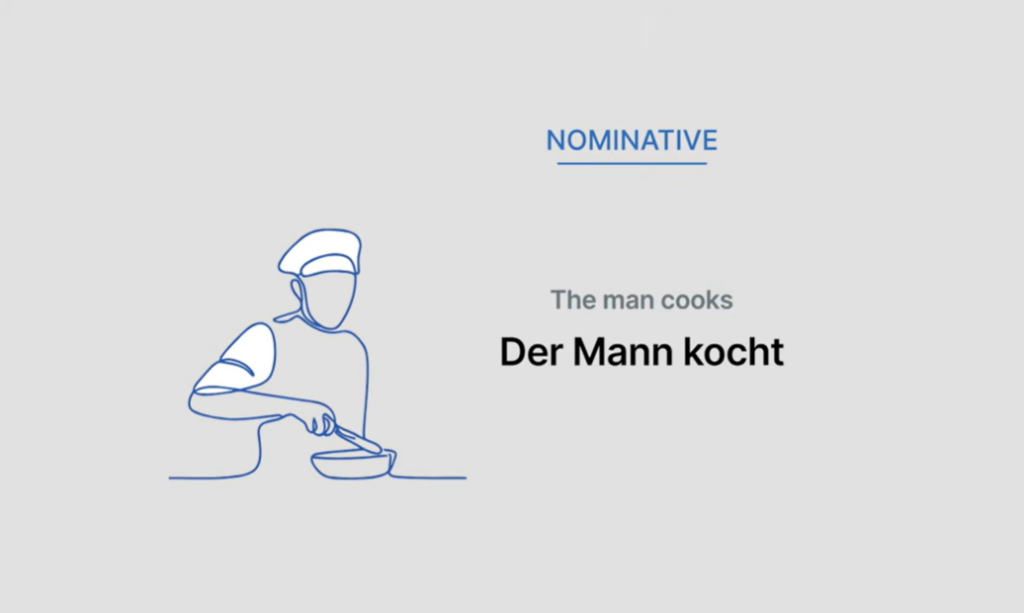
This one’s easy, it’s used for the subject, the person or thing doing the action. The articles and pronouns we’ve seen so far were all in the nominative case. For example: Der Mann kocht. – The man cooks or the man is cooking. Here, der Mann is the one doing the action of cooking something, so it’s nominative. So whenever you see “who” or “what” is performing some action, that’s nominative.
2. Accusative Case
The accusative is used for the direct object the thing that’s directly affected by the action.
For example:
Der Mann kocht den Reis. The man is cooking the rice. Here, der Mann is the one cooking the rice, so he stays in the normal form (nominative). But der Reis is the thing being cooked, so it changes to accusative and becomes den Reis. That’s the key thing to remember — the masculine article “der” changes to “den” in the accusative. Everything else stays the same:
- die (feminine) stays die,
- das (neuter) stays das,
- die (plural) stays die.
You remember the personal pronouns we learned earlier. Along with articles der, der das, the accusative case also has an impact on pronouns. So, in the accusative form, ich becomes mich, du becomes dich, er becomes ihn, sie stays sie, es stays es, wir becomes uns, ihr becomes euch, and sie or Sie stays the same.
Now let’s see them in action:
“Ich sehe dich.” I see you. Ich is the subject in the nominative case, and dich is the object in the accusative case. So instead of “Ich sehe du”, it becomes “Ich sehe dich”
Similarly
Ich sehe ihn. – I see him.
Ich sehe sie. – I see her.
Ich sehe es. – I see it.
Ich sehe uns. – I see us.
Ich sehe euch. – I see you all.
Ich sehe sie. – I see them.
Ich sehe Sie. – I see you (formal).
3. Dative Case
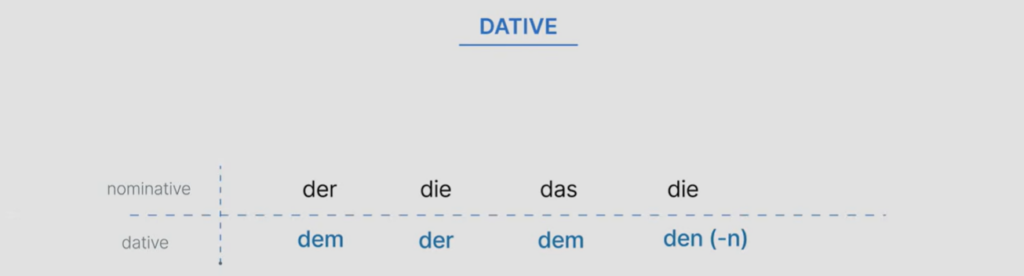
Now, if the accusative case is for the direct object, the Dative Case is used for indirect objects basically, when something is done to or for someone.
And here’s how the articles change in dative:
Masculine: der → dem
Feminine: die → der
Neuter: das → dem
Plural: die → den and the noun usually gets an extra n
For example:
Der Mann bringt dem Kind den Reis. The man cooks the rice for the child. Here, Der Mann is the one doing the action, so he’s in the nominative case. Den Reis is what’s being cooked the direct object so that’s accusative. And dem Kind is for whom the action is done the indirect object so it’s dative. Since Kind is neuter (das Kind), it changes to dem Kind in the dative case.
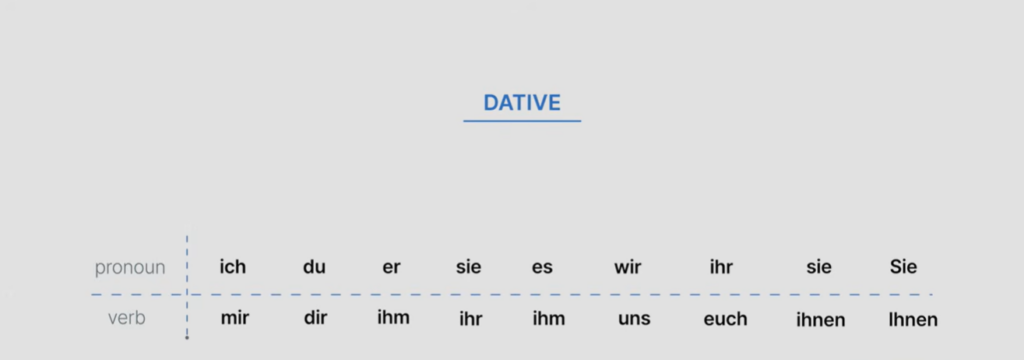
Now just like in accusative case, perosnal pronouns change their form in dative: So, ich → mir, du → dir, er → ihm, sie → ihr, es → ihm, wir → uns, ihr → euch, sie/Sie → ihnen/Ihnen.
Now let’s look at some examples:
Ich gebe dir das Buch. I give you the Book.
Ich gebe uns das Geschenk. “I give us the gift.”
Ich gebe euch das Geschenk. “I give you all the gift.”
So, to sum it up:
Who does it? That’s Nominative.
What is it? that’s Accusative.
Who gets it? That’s Dative.
Prepositions
Now let’s talk about prepositions those small but powerful words that connect ideas in a sentence, like “in,” “on,” “to,” or “with.” Remember when we answered questions like “Woher kommst du?” Ich komme aus Indien or “Wo wohnst du?” Ich wohne in Stuttgart? Here, “aus” and “in” are prepositions.
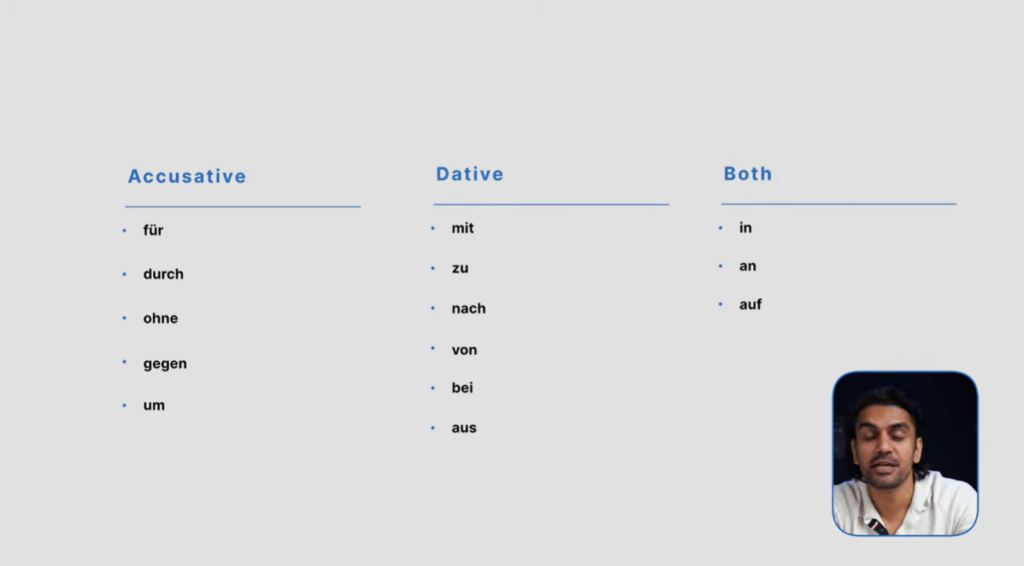
Before we jump into the most common ones, there’s something important to remember. Some prepositions in German always take the accusative case, some always take the dative, and a few can take both depending on the situation. So when you learn a preposition, make sure you also learn which case it uses.
Here are the most common accusative-only prepositions you’ll learn at A1:
- für – for
- Ich habe ein Geschenk für dich. Here, für is an accusative preposition, so the pronoun du changes to dich.
- durch – through
- Wir gehen durch den Park. We’re walking through the park. Park in German is der Park, and its accusative form is den Park
- ohne – without
- Das Kind spielt ohne den Ball. The child plays without the ball.
- Gegen usually means against, but it can also mean around when talking about time. For example:
- Er ist gegen die Idee. – He’s against the idea.
- Wir kommen gegen acht Uhr. – We’ll arrive around eight o’clock.
- Um can also mean around, but it’s mainly used to talk about a specific time or movement around something.
- For example:
- Wir sitzen um den Tisch. – We’re sitting around the table.
- Der Film beginnt um sieben Uhr. – The movie starts at seven o’clock.
- For example:
Some prepositions always take the dative case, no matter what. These include:
- mit – with
- In “Ich fahre mit dem Bus,” the word Bus is neuter das Bus. But since the preposition mit always takes the dative case, das changes to dem, so it becomes mit dem Bus. And in “Ich spreche mit Freunden. I talk with friends.,” the word Freunde (friends) is plural. In the dative plural, most nouns add an extra -n. So it becomes Freunden. That’s why it’s mit Freunden not mit Freunde.
- zu – to
- Ich gehe zum Arzt. – I’m going to the doctor. Here, zum is simply a combination of zu + dem. The word Arzt (doctor) is masculine der Arzt. Since zu always takes the dative case, der changes to dem, and zu + dem becomes zum. So we get zum Arzt.
- Similarly: Mein Sohn geht zur Schule. – My son goes to school. Here, zur is a combination of zu + der. Schule (school) is feminine die Schule. In the dative case, die becomes der, and zu + der becomes zur. So, zu der Schule → zur Schule.
You get the idea right. Let’s see a few more dative prepositions.
- nach – after
- Ich schlafe nach dem Essen. – I sleep after eating.
- von – from
- Ich komme vom Bahnhof. – I’m coming from the train station. Vom is von + dem
- Sie kommt von der Arbeit. – She’s coming from work. Arbeit is die Arbeit, feminine so in dative it becomes der Arbeit.
- bei – at / with
- Ich wohne bei meinen Eltern. – I live with my parents.
- Er ist bei der Arbeit. – He’s at work.
- aus – from / out of
- Er nimmt das Buch aus der Tasche. – He takes the book out of the bag.
Then, there are two-way prepositions, which can take either dative or accusative, depending on whether you’re talking about a particular location (where something is) or movement (where something is going). The most common two-way prepositions are:
- in – in/into
- an – at/on/to
- auf – on/onto
Let’s take “in” as an example.
Ich gehe ins Restaurant. I’m going into the restaurant. Here, we’re talking about movement you’re going somewhere. In this case, “in” takes the accusative case. The word Restaurant is neuter das Restaurant. In the accusative, das stays das. So in + das Restaurant becomes ins Restaurant.
Now, once you’re already at the restaurant, and you want to tell someone where you are, you say: Ich bin im Restaurant. I’m in the restaurant. Here, we’re talking about a location, not movement, so “in” takes the dative case. Since das Restaurant in the dative becomes dem Restaurant,
“in” + dem Restaurant shortens to im Restaurant.
So in short, with location → Dative and with movement → Accusative
Now you might be wondering, are there Nominative prepositions? The answer is No. And here’s why: the nominative case is used only for the subject of a sentence — the person or thing doing the action. Prepositions, on the other hand, always connect a noun or pronoun to something else in the sentence, which means that the noun can’t be the subject anymore.
Perfekt – The Present Perfect Tense
Now, you might be the most future-minded person out there always thinking ahead, planning your next move. But sooner or later, you’ll have to talk about something that’s already happened. Like when someone asks, “So, what did you do on the weekend?” The best way to talk about your last weekend in German is by using the Perfekt tense.
Now don’t worry — it sounds fancy, but it’s actually really simple. The Perfect tense or present perfect is made up of just two parts.
Remember the verbs haben and sein we talked about earlier? You’ll need one of them as the auxiliary verb in the first part. And the second part is the past participle of the main verb, and that one always goes to the end of the sentence.
So the structure looks like this:
Subject + auxiliary verb (haben/sein) + … + past participle form of the verb.
For example: “Ich bin ins Restaurant gegangen.” – “I went to the restaurant.” Here, bin is the ich form of sein, used as a helping verb, and gegangen is the past participle of gehen (to go).
or
Wir haben viel gegessen. – We ate a lot. Here, haben is the wir form of the verb haben, used as the auxiliary verb. And gelernt is the past participle of lernen (to learn).
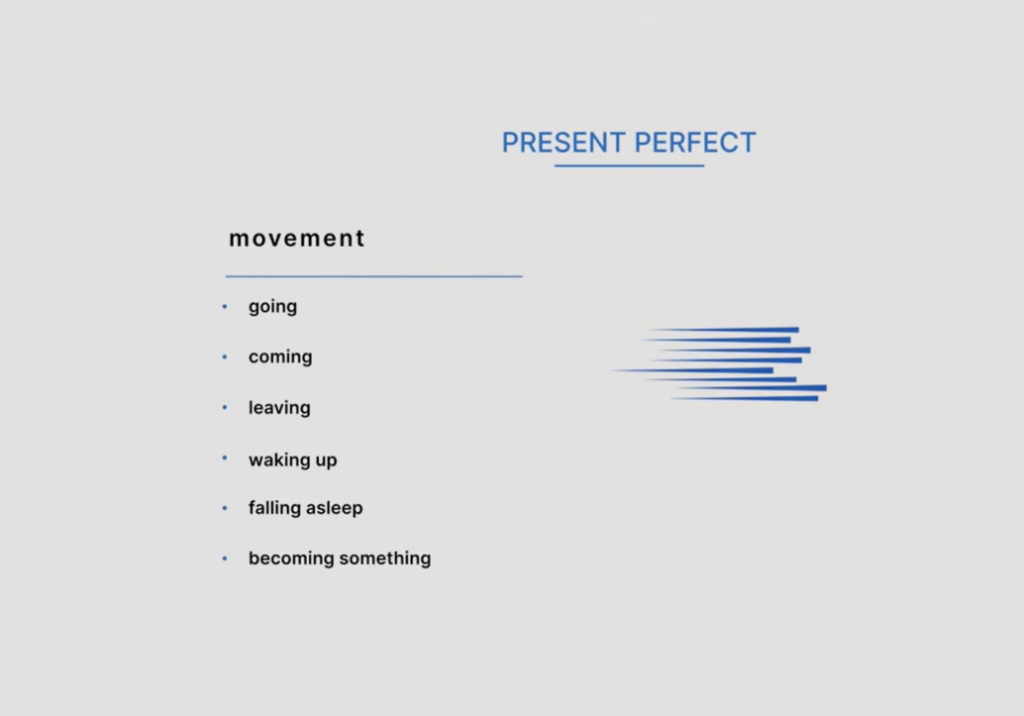
So, when do you use sein and when do you use haben? Here’s the simple rule: If the verb shows movement (like going, coming, leaving) or a change of state (like waking up, falling asleep, becoming something), you usually use sein. For example: Er ist spät gekommen. – He arrived late.
There’s movement he’s arriving somewhere so we use sein.
And since it’s er, the correct form of sein is ist.
For pretty much everything else, you use haben. For example: Ich habe gestern gearbeitet. – I worked yesterday. There’s no movement or change of state here — just an action — so haben is the right choice.
Now, to the second part, how do you form those past participles? For most regular verbs, it follows a super-easy pattern: Take the verb stem, add ge- at the beginning, and -t at the end. So basically: ge- + stem + -t. Consider the verb spielen or to play, the stem is spiel and becomes gespielt; similarly, machen becomes gemacht.
Then you have verbs ending in –ieren, like studieren (to study) or telefonieren (to make a phone call). These never take ge– at all in their past participle form.
So they become:
- studiert
- telefoniert
Now, for some Irregular verbs, the past participle form often ends in –en, sehen, to see, becomes gesehen, essen, to eat, becomes gegessen
For some verbs, the vowel inside the word also changes in the past participle form.
For example:
- gehen, to go, becomes gegangen
- trinken, to drink, becomes getrunken
- finden, to find becomes gefunden
For verbs with separable prefixes, like anrufen (an + rufen – to call), the ge– sneaks right in the middle when forming the past participle. So it becomes angerufen.
Other examples are:
- aufstehen → aufgestanden (to get up → got up)
- einkaufen → eingekauft (to shop → shopped)
And verbs starting with inseparable prefixes such as be–, ver–, er–, ent–, zer– also don’t get the ge– prefix.
For example:
- besuchen → besucht (to visit → visited)
- verstehen → verstanden (to understand → understood)
- erzählen → erzählt (to tell → told)
I know this can feel a bit complicated at first, but honestly, the best way to get it right is to learn the past participle together with the verb. Because if you do, the next time someone asks what you did over the weekend, you’ll know exactly how to answer—in perfect Perfekt.
Basic Modal Verbs (Können, Müssen, Wollen)
Now, by this point, you already know enough to make simple conversations in German especially if you can pick up some basic vocabulary. But if you really want to sound more natural, more like how people actually speak, then you can’t skip learning modal verbs.
Modal verbs are like small helpers in your sentences. They let you say things like what you can do, what you must do, or what you want to do.
At the A1 level, the most common modal verbs you’ll learn are können (can/to be able to), müssen (must/have to), and wollen (want to). Later, you’ll also learn dürfen (may/be allowed to) and sollen (should), but let’s stick to the main three for now.
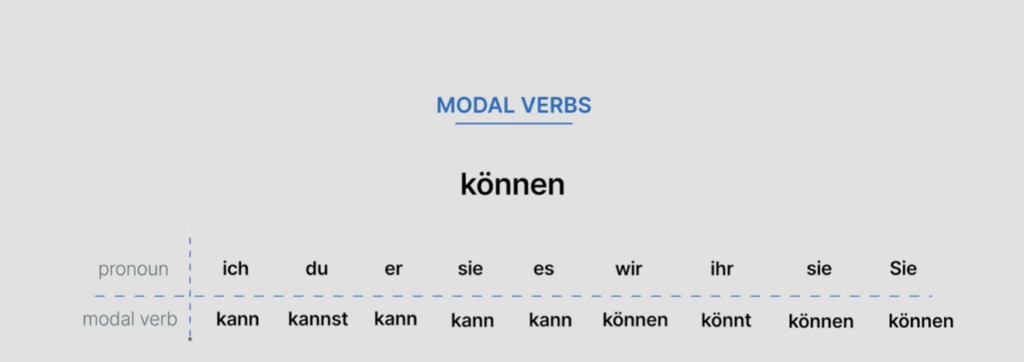
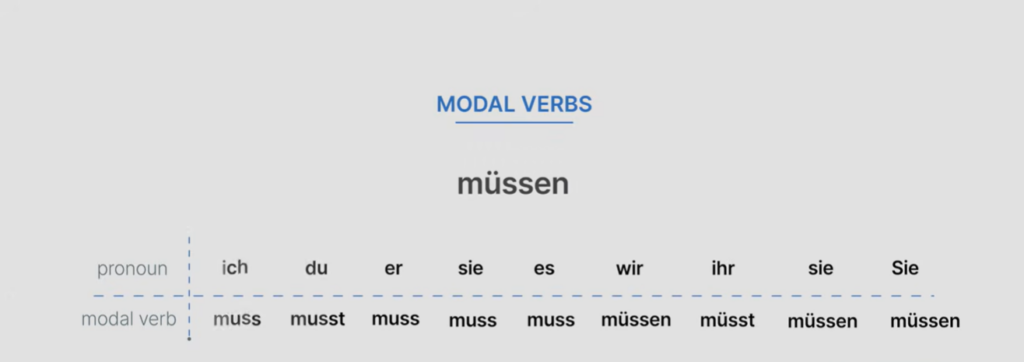
Just like regular verbs, modal verbs also change their form depending on who’s doing the action. For example, können becomes ich kann, du kannst, er/sie/es kann, wir können, ihr könnt, sie/Sie können. Müssen changes to ich muss, du musst, er/sie/es muss, wir müssen, ihr müsst, sie/Sie müssen. And wollen becomes ich will, du willst, er/sie/es will, wir wollen, ihr wollt, sie/Sie wollen.
But here’s something different about them that you need to remember: In a sentence with a Modal verb, the main verb gets pushed to the end of the sentence, in its infinitive form.
For example, instead of saying Ich spreche Deutsch (I speak German), you’d say Ich kann Deutsch sprechen — I can speak German. Here, kann is the conjugated form of können for “ich,” and the regular verb sprechen moves to the end of the sentence. Another example: Du musst heute arbeiten — You must work today. Must comes from müssen, and arbeiten (to work) again goes to the end of the sentence.
And this is actually really helpful when you’re just starting to speak German. You can begin with the right model verb, and even if you forget the main verb for a second, that’s okay. You’ll have a bit of time to remember it, since it always comes at the end of the sentence.
So in summary [Subject] + [modal verb (conjugated)] + … + [infinitive form of main verb at the end].
Now let’s move on to a few more important topics that are also part of the A1 level — especially the ones that help you react to different situations in real life.
Imperative
The imperative is basically how you tell someone to do something, like giving an order or an instruction.
In informal situations, when you’re talking to friends, classmates, or family, you just use the verb stem (that’s the infinitive without the “-en” at the end).

For example:
Komm! – Come! (from kommen)
Warte! – Wait! (from warten)
When you want to be polite or are talking to someone you don’t know well, use the infinitive form + Sie, and you can also add bitte to sound extra polite.
For example:
Sprechen Sie bitte langsamer. – Please speak more slowly.
And if you’re talking to more than one person, use the normal conjugated verb form for ihr.
For example:
Kommt her! – Come here (you all)!
Wartet mal! – Wait a moment (you guys)!
Possessive Adjectives

Possessive adjectives are super useful because you can use them before a noun to show ownership. These are words like my, your, his, her, our, etc.
In German, they look like this:
mein – my
dein – your (informal, singular)
sein – his
ihr – her
unser – our
euer – your (plural, informal)
ihr – their
Ihr – Your (formal)
So far, pretty simple, right? But here’s where it starts to get a little tricky just like der, die, das change with the gender and case of a noun, the possessive words also change their endings. That’s why “my father” and “my mother” won’t both be mein in German.
When the noun is the subject of the sentence, or what we call the nominative case, the ending of the possessive word changes just a little. Feminine and plural nouns take an -e at the end, so mein becomes meine. Masculine and neuter nouns? They just stay as mein.
Now, that’s when the noun is the subject of the sentence. But if the noun becomes the object meaning something is being done to it that’s the accusative case. And here’s the good news: only one thing changes. The masculine form gets an extra -en at the end.
So instead of saying Ich sehe mein Vater, you say Ich sehe meinen Vater “I see my father.” Here, mein Vater is the object, so it changes to meinen Vater in the accusative case.
For example:
- Ich kenne deine Mutter. – I know your mother. (Mutter is feminine, so it stays the same just adds the normal “-e.”)
- Wir besuchen unsere Freunde. – We visit our friends. (Freunde is plural, so it also ends with “-e.”)
So the key difference between the nominative and accusative forms is this: only the masculine one changes from mein to meinen. Everything else stays exactly the same.
Now, the dative case shows to whom or for whom something is done. It often comes after certain verbs like helfen (to help), geben (to give), danken (to thank), or prepositions like mit, von, bei, zu. This is where the endings change the most, so masculine and neuter get -em, feminine gets -er, and plural gets -en.
Let’s look at a few examples:
Ich spreche mit meiner Schwester. – I speak with my sister. Now, Schwester (sister) is feminine die Schwester and because of the preposition mit, the noun goes into the dative case. So the possessive word mein takes the -er ending and becomes meiner Schwester.
Now let’s look at an example where both accusative and dative come together.
Ich gebe meinem Bruder meinen Ball. – I give my brother my ball.
- Ball (ball) is masculine – der Ball – and it’s the object, the thing being given. That’s the accusative case, so it becomes meinen Ball.
- Bruder (brother) is masculine – der Bruder – and he’s the one receiving the ball. That’s dative, so mein becomes meinem Bruder.
So together we get:
Ich gebe meinem Bruder mein Buch.
So, in short, here’s the quick pattern you can always keep in mind:
Feminine and plural nouns get an -e ending in the nominative case.
Masculine in accusative takes -en. And in the dative case, the endings go like this: -em, -er, -em, -en.
Now that we understand how mein, dein, sein, ihr, unser, and all those possessive words work, let’s look at something very similar ein and kein. Because all three behave almost the same way.
In addition to the definite articles der die and das, German also has the indefinite article “ein” which corresponds to “a/an” in English. We say “a man,” “a woman,” “a child.” right. So ein works just like the indefinite article “a” in English. Now kein is used to negate nouns that have an indefinite article or no article at all. Think of kein as the opposite of ein.
And just like der, die, das, it has to match the gender and case of the noun.
In Nominative form,
- a man becomes ein Mann
- a woman becomes eine Frau
- a child becomes ein Kind
- kein Mann – no man / not a man
- keine Frau – no woman / not a woman
- kein Kind – no child / not a child
- keine Kinder
Notice how the feminine form adds an -e at the end so it’s eine Frau and keine Frau. The same thing happens in the plural too both ein and kein take -e at the end. But here’s the thing: ein itself doesn’t have a plural form. You can say keine Kinder (no children), but you can’t say ein Kinder. There’s simply no “a” in the plural because you can’t say “a children” in English either, right?
If we put that in sentences, we get,
- Ich habe kein Auto. – I don’t have a car.
- Er ist kein Lehrer. – He is not a teacher.
- Sie hat keine Kinder. – She has no children.
Just like articles and possessive adjectives, ein and kein also change depending on the case. If the noun is in the accusative, they take the accusative endings. And if it’s in the dative, they take the dative endings. Simple as that they all follow the same pattern.
Let’s look at a few examples:
Nominative:
– Das ist ein Mann. – That’s a man.
– Das ist keine Frau. – That’s not a woman.
Accusative:
– Ich sehe einen Mann. – I see a man.
– Ich sehe keinen Mann. – I see no man.
Dative:
– Ich spreche mit einem Mann. – I’m talking with a man.
– Ich spreche mit keinem Mann. – I’m talking with no man.
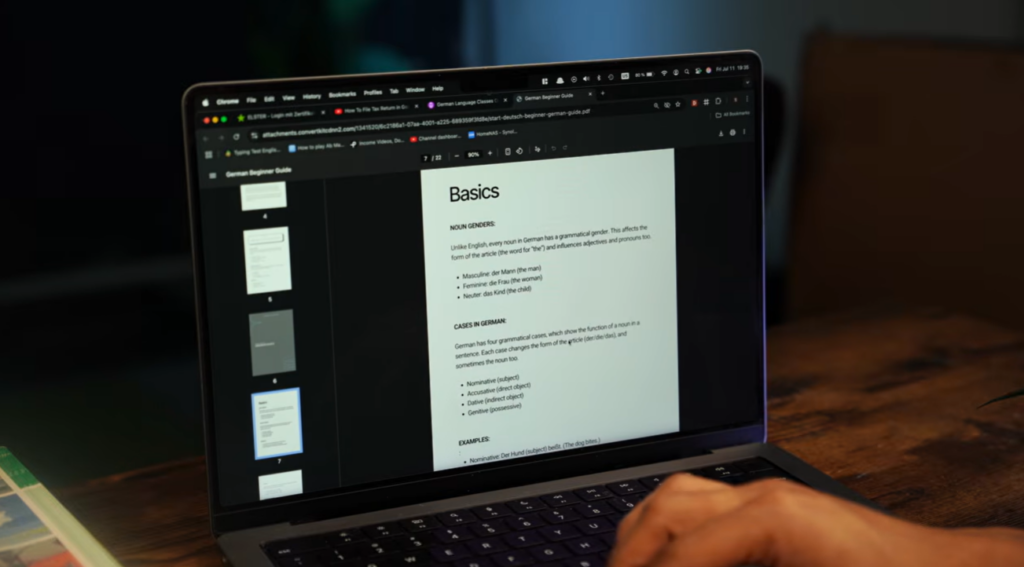
Here’s the complete table with ein, kein, and mein across all the cases so you can see how they all follow the exact same pattern. And don’t worry if this feels like a lot right now. I’ll leave you with a quick starter guide that has all this information neatly organized, so you can come back to it anytime and learn it by heart later.
Here’s the full table with ein, kein, and mein across all the cases so you can see how they follow the exact same pattern. And don’t worry if it feels like too much right now. I’ll leave you with a quick German starter guide that has everything neatly organized, so you can revisit it anytime and slowly get it memorized.
Time – Manner – Place
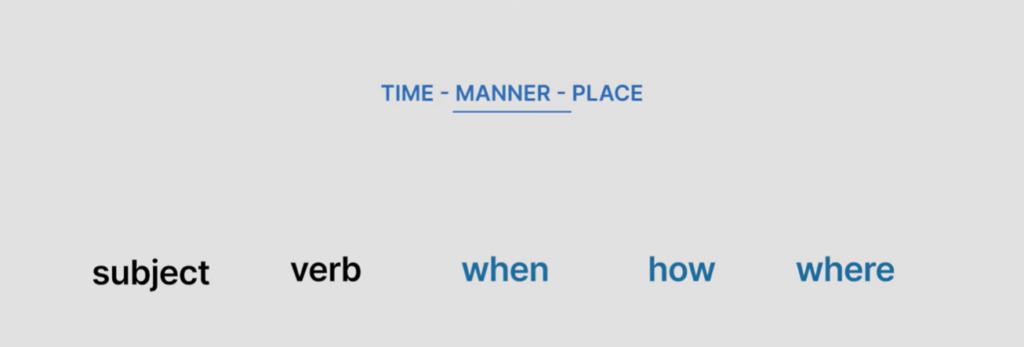
When forming sentences in German, there’s one simple rule that’ll instantly make you sound more natural: Time – Manner – Place. That means, after the verb, you usually say when something happens, then how, and finally where.
For example:
Ich gehe heute mit dem Bus nach Hause. – I’m going home today by bus. Here, heute tells when, mit dem Bus shows how, and nach Hause tells where. Simple right?
Conjunctions: Connecting Ideas
Now you’re getting better and better at forming individual sentences that sound clear and natural. But what if you want to connect two sentences?
That’s where conjunctions come in little words like “and,” “but,” or “or” in English. In German, the most common ones you’ll use at the A1 level are und (and), aber (but), oder (or), and denn (because).
For example:
Ich lerne Deutsch und ich arbeite. – I learn German and I work.
Ich wohne in Berlin, aber ich komme aus Indien. – I live in Berlin, but I’m from India.
Trinkst du Kaffee oder Tee? – Do you drink coffee or tea?
Ich bleibe zu Hause, denn ich bin müde. – I’m staying at home because I’m tired.
Denn is one way to say “because” in German but there’s another super common one: weil. For example Ich bleibe zu Hause, weil ich müde bin. – I’m staying at home because I’m tired. Both denn and weil mean the same thing, but there’s one key difference when you use weil, the verb moves to the end of the sentence just like with Modal verbs. Don’t worry if that feels tricky right now; that’s something for later. For now, it’s totally fine to use Denn, since it keeps the normal word order and is much easier to get used to.
Each of these topics could easily be a full lesson on its own but even just knowing about them already gives you a huge head start.
Alright, now let’s talk about something super practical vocabulary. Because let’s be honest, even if you know all the grammar rules, you can’t really say much without the right words, right? So, let’s go through some of the most useful words you’ll need for everyday life in Germany.
Numbers and Counting in German
Let’s start with numbers because at some point, you’ll run out of fingers to count on. You’ll need them to tell the time, talk about your age, ask prices, or say quantities.
Here are the numbers from 0 to 10. Just repeat after me.
- 0 – null
- 1 – eins
- 2 – zwei
- 3 – drei
- 4 – vier
- 5 – fünf
- 6 – sechs
- 7 – sieben
- 8 – acht
- 9 – neun
- 10 – zehn
- 11 is elf and 12 is zwölf.
From 13 to 19, things get much easier. There’s a clear pattern you just take the number and add -zehn (which literally means “ten”). So 13 becomes dreizehn (“three-ten”), 14 is vierzehn, 15 is fünfzehn, and so on, all the way to 19 neunzehn.
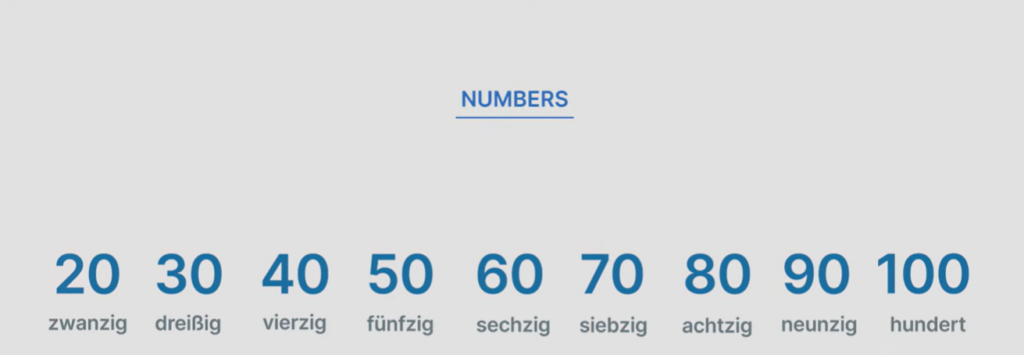
Now for the multiples of ten 20 is zwanzig, 30 is dreißig, 40 is vierzig, 50 is fünfzig, 60 is sechzig, 70 is siebzig, 80 is achtzig, 90 is neunzig, and 100 is hundert. Most of them end with -zig (pronounced “tsig”), except 30, which ends with -ßig (pronounced “ssig”).
Now, after 20 is where it starts to get a little tricky especially for English speakers. In German, 21 isn’t “twenty-one,” it’s actually said the other way around: “one and twenty” einundzwanzig (literally “one and twenty”). And the same pattern continues 22 is zweiundzwanzig, 23 is dreiundzwanzig, and it keeps going like that all the way up to 29 neunundzwanzig.
I know German really can mess with your brain sometimes. But don’t worry, there’s one golden rule to keep things simple: say the smaller number first, then “und”, and then the larger base. That’s how it works for all numbers between 21 and 99, except for the clean multiples of ten.
A few more useful numbers before we wrap up 100 is einhundert (or just hundert), 101 is einhunderteins, and 1000 is tausend. But for now, as a beginner, you don’t need to go that far. You’ll mostly use numbers for everyday things like age, time, and prices. So learning up to a hundred is more than enough to get you started.
Another really common place you’ll use numbers is when telling the time.
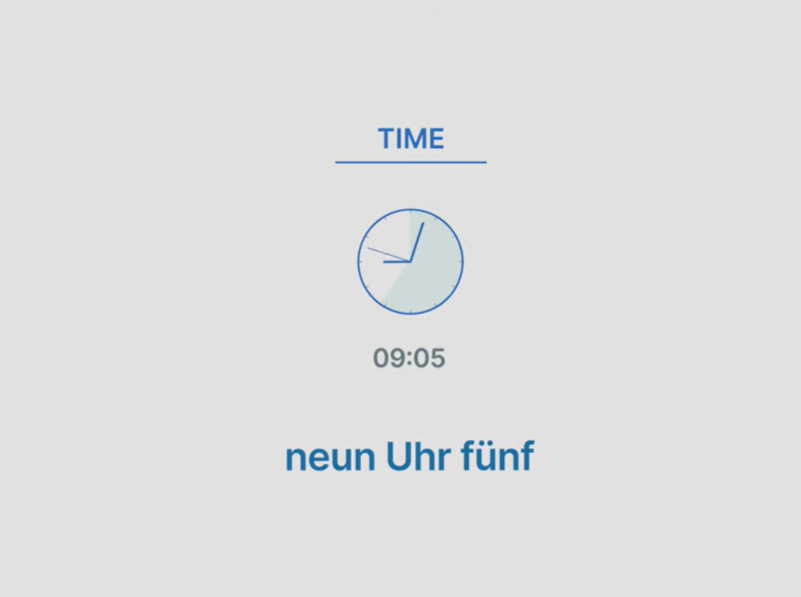
And there are two main ways to tell time in German. The first one is the official way the kind you’ll hear in timetables, announcements, or anything formal. Here, you simply say the hour and minute, with the word Uhr in between. For example, 14:30 becomes vierzehn Uhr dreißig (literally “fourteen hour thirty”), and Neun Uhr fünf means “9:05.”
To ask for the time in German, you can say Wie spät ist es? or Wie viel Uhr ist es? both mean “What time is it?” When answering, just start with Es ist… and then say the time. For example, Es ist zehn Uhr dreißig “It’s 10:30,”
Now, when you’re talking about the exact time something happens, you’ll need a preposition, um. So you’d say um 7 Uhr (at seven o’clock) or example: Der Film beginnt um 20:15 Uhr “The movie starts at 8:15 p.m.”
But in everyday conversations, we usually don’t say the full time like that. Instead, we use fractions of the hour just like in English. For example, Viertel nach zwei means “quarter past two.” Here, Viertel means “quarter,” nach means “after,” and zwei means “two.” Similarly, Viertel vor drei means “quarter to three.”
Now, here’s the part that confuses almost every learner when a train departs at halb drei, it actually means “half to three,” or 2:30, not 3:30.
So yeah, keep that in mind, or you might end up waiting at the station for an hour, wondering why the train never showed up.
Alright, now let’s talk about the days of the week or Wochentage in German. You can repeat after me.
Montag – Monday
Dienstag – Tuesday
Mittwoch – Wednesday
Donnerstag – Thursday
Freitag – Friday
Samstag – Saturday
Sonntag – Sunday
All the days of the week are masculine so it’s der Montag, der Dienstag, and so on but in normal conversation, we usually drop the article.
And just like when talking about time, if you want to say “on Monday” or “on Tuesday,” you use the preposition am, which actually comes from an + dem in the dative form. So am Montag means “on Monday,” am Dienstag means “on Tuesday,” and so on.
For example:
Wir haben am Mittwoch Deutschkurs. – “We have German class on Wednesday.”
In German, when we talk about dates, we use ordinal numbers just like saying “first,” “second,” or “third” in English. You wouldn’t say ten of December, right? You’d say the tenth of December. German does the same thing, but it just has its own way of adding that little “th” ending.
From 1 to 19, ordinal numbers end with -ten.
For example:
am siebten März – on the 7th of March
am dritten Juli – on the 3rd of July
From 20 onwards, they end with -sten.
For example:
am einundzwanzigsten Oktober – on the 21st of October
am dreißigsten April – on the 30th of April
So just remember this simple rule:
1–19 → -ten
20 and above → -sten
And the word “am” before it simply means “on.”
And of course, along with the days, you’ll also need to know the months or Monate in German. So repeat after me,
Januar – January
Februar – February
März – March
April – April
Mai – May
Juni – June
Juli – July
August – August
September – September
Oktober – October
November – November
Dezember – December

Pretty simple, right? Most of them look almost the same as in English, just with that little German twist in pronunciation. Also, all months are masculine — so it’s der Januar, der Februar, and so on. But, just like with days of the week, you usually drop the article unless there’s a reason to use it.
And similar to days of the week, if you want to say in January or in March, you use im, which comes from in + dem.
For example:
Es ist kalt im Januar. – “It’s cold in January.”
Wir machen Urlaub im Juli. – “We go on vacation in July.”
So, to quickly wrap it up:
um → used with time → um 7 Uhr (at 7 o’clock)
im → used with months → im Juli (in July)
am → used with days and dates → am Montag (on Monday), am dritten Juli (on the 3rd of July)
Conclusion
We’ve covered quite a lot together so far from the alphabet and pronunciation, to greetings, introductions, and some key grammar basics like pronouns, verb conjugations, and sentence structure. Of course, X minutes isn’t enough to learn an entire language, but that’s a lot already! And here’s the thing with a bit of dedication and regular practice, you’ll move past A1 before you even realize it. Just stay consistent. Even 30 minutes a day can make a huge difference.
And don’t be afraid to make mistakes that’s honestly the best way to learn. Start small. Build short, simple sentences and say them out loud. Try introducing yourself or asking your friends easy questions in German. The more you use the language, the faster it’ll stick.
And to make things easier, I’ve put together a complete beginner’s guide with all this information written down. You can download it from the link in the description below.
If you remember, I told you I’ve got a little trick to help you memorize vocabulary, grammar, and everything else. So, I’ve built a small web app that does exactly that it helps you learn German using flashcards based on proven techniques like spaced repetition and active recall. You can check it out through the link below.
I hope this has given you a solid foundation to start your German journey. I’m also thinking about making similar content for the next levels in the future so stay tuned! Danke schön for watching and bis zum nächsten Mal!