

If you’re living in Germany right now, you’ve probably heard the news. [Broll of Layoff news about layoffs in German TV]. Big stable companies the ones we all thought were untouchable are cutting thousands of jobs and letting people go. You could be the employee of the year, and doing everything right, and still… find yourself on that list. Look, I know losing a job is one of the hardest things you can go through. Especially when you’re far from home, in a foreign country, and everything feels uncertain. But here’s the truth: people move to Germany not just for better salaries, but for the strong worker protections this country provides. And these protections only work if you know about them and use them.

I’m going to answer all those important questions. What are your rights? What benefits can you claim? What happens to your visa and your health insurance? And then most importantly, the three important things you must do right now to get you prepared. Because the worst time to learn all this is when you’re already in the middle of it.
THE FIRST 24 HOURS
So let’s say it happens. One morning, your manager calls you into a meeting. And tell you: you’re fired. What do you do first?”
Whatever you do, just don’t panic. I know it’s easier said than done. Still try not to get emotional. Don’t argue or create a scene. Just listen to what your manager or HR is saying. Because knowing the reason why they want to fire you matters a lot.

In Germany, there are three main reasons for a layoff.
First: Personal reasons. This is the case when your performance wasn’t up to the mark, or maybe the company doesn’t see you as a fit anymore. But here’s the thing they can’t just say that and fire you. They need to show proof. Documented proof that they warned you, gave you time to improve, and still you didn’t.
Now the second one is Behavioral reasons. These could be things like not showing up on time, refusing to do your work, or breaking company rules. Again, just like in the first case, the company has to present evidence. They can’t just fire you on the spot.
And third: Operational reasons. This is the big one. In German, it’s called betriebsbedingte kündigung. It means that the company is making structural changes like closing a department, shutting down a location, or cutting costs because of financial problems.
Now, this is where it gets interesting. Because even with operational reasons, the company can’t just randomly pick employees to fire. They have to follow something called Sozialauswahl or social selection. They have to consider things like your age, years of service, whether you have a family to support, or if you have some kind of disability. So they can’t just let go of a 50-year-old with three kids while keeping a 25-year-old who’s single even if that 25-year-old is more productive. That’s why companies don’t always go this route. Because it’s complicated. And expensive.
So, the first thing you do? Understand why they’re letting you go. And remember: this is not the time to argue. This is the time to be calm and gather information. But understanding the reason is only the first step. Because what comes next is even more important.”
THE TERMINATION LETTER
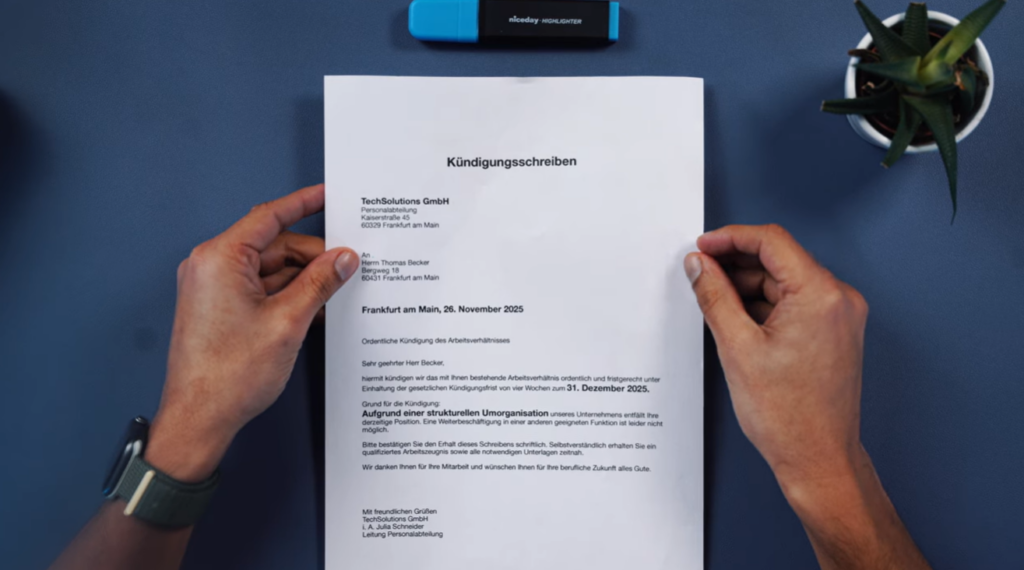
After that initial meeting, your employer will give you a termination letter. In German, it’s called Kündigungsschreiben. This will have your name, the notice period, and the reason for termination. This is the one document that makes everything official. And this is the document you’ll need when you go to the government, when you talk to a lawyer, or when you apply for unemployment benefits. So check everything. Make sure the details are correct and the signature is there.
This letter has to be delivered to you physically. Not via email. Not as a WhatsApp message. Not over a phone call. It has to be on paper, with a signature. Nothing else counts.
Now, sometimes your employer will ask you to sign a confirmation that you received the letter. That’s fine. Signing it just means you got the letter. It doesn’t mean you agree with the termination.
But and this is important sometimes employers will try to give you a different document. It’s called an Aufhebungsvertrag or termination agreement. And this is where people make a huge mistake.
If you sign this document, you’re not getting fired. You’re agreeing to leave. You’re saying: ‘Yes, I want to end my contract.’ So under no circumstances—I repeat, under no circumstances should you sign this without completely understanding the situation and giving a good thought about it. Your employer can’t force you to sign it. So just take the termination letter and leave.
CONTACT THE AUTHORITIES
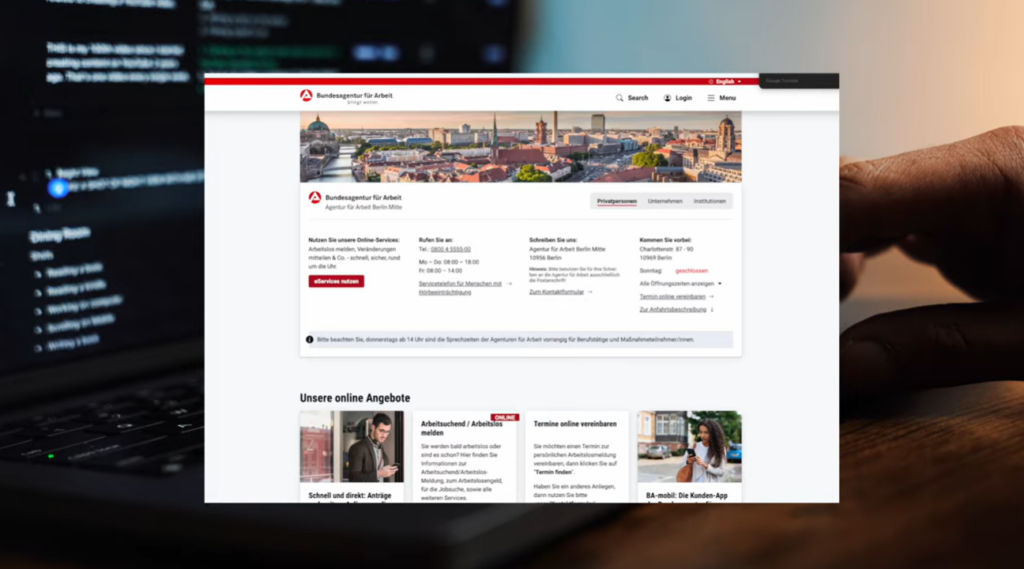
Alright, so once you’ve got the termination letter, you need to contact the Bundesagentur für Arbeit within three days. This is the German employment agency that handles unemployment benefits and offers job search support. You can do this in person, online, or by phone. Just Google ‘Agentur für Arbeit’ with your city name, and you’ll find the contact details. They’ll set up an appointment and guide you through the next steps.
The second thing you need to do is check if your company has a Betriebsrat a workers’ council. If they do, go talk to them within ten days. The workers’ council has real power. They can challenge the layoff or negotiate on your behalf. And in some cases, they can actually stop the termination from happening. But if that doesn’t work, and you feel the termination is unfair, it is time to take the matter to court.
THE DISMISSAL PROTECTION LAWSUIT

In Germany, if you’ve completed your probation period and you work in a company with more than 10 employees, you have the right to challenge your dismissal in court. It’s called Kündigungsschutzklage, or dismissal protection lawsuit.
And you have exactly three weeks from the day you get that termination letter to file it. After three weeks, it’s over. Even if the termination was completely illegal, you can’t do anything about it.
So talk to a lawyer without delay. And I know what you’re thinking: ‘But lawyers are expensive.’ And yes, they are. That’s why you need legal insurance. If you don’t, most lawyers will still give you a free 10 to 15-minute consultation. They’ll look at your case and tell you if you have a chance.
Now, the goal of this lawsuit is usually to get your job back. But here’s what actually happens most of the time: the company might offer you a settlement as a compromise called Abfindung or severance pay.
Now, how much this would be depends mostly on two factors. How long have you worked for that company, and how difficult would it be for the company to fire you otherwise? As a general rule, you can expect around half a month’s salary to two months’ salary for every year of service. So if you’ve been at the company for five years, you could get anywhere from 2.5 to 10 months’ salary as a settlement.
Now, you can accept that deal, or you can refuse it and keep fighting. But once you accept it, it’s final. You can’t change your mind. So read the agreement carefully. Talk to your lawyer. Make sure you understand everything and you’re getting what you deserve.
And here’s the thing: even if you take the settlement, your employer still has to give you your full notice period. They can either make you work or they can send you on garden leave. Either way, you still get your full salary, your bonuses, your sick days, and your vacation days. All of it.
UNEMPLOYMENT BENEFITS AND HEALTH INSURANCE

“So let’s say your notice period is over. You’ve left the company and you haven’t found a new job yet. What happens now?
If you were forcefully dismissed meaning you didn’t take a severance deal and sign that termination agreement you’re eligible for Arbeitslosengeld, or unemployment benefits, immediately. You’ll get around 60% of your previous salary. Or 67% if you have kids.
But if you took the severance deal, here’s the catch: you have to wait three months before you can get unemployment benefits. So in some cases, it might actually be more beneficial to refuse the severance pay and take the unemployment benefits instead. It totally depends on your situation.
Now, not everyone qualifies for unemployment benefits; you need to have worked and paid social security contributions for at least 12 months. If you worked for 12 months, you get benefits for 6 months. If you worked for 2 years or more, you get benefits for up to 12 months.
Now, what about health insurance? If you’re on public health insurance, don’t worry your coverage doesn’t just disappear. But you do need to inform your insurance provider right away that you’ve lost your job. And for a short time period, until your unemployment benefits officially start, you’ll have to cover insurance payments on your own. After that, once the benefits kick in, the unemployment agency takes over and starts paying for your health insurance.
YOUR VISA AND RIGHT TO STAY IN GERMANY

Now, if you’re an EU citizen or you have a German permanent residence permit, losing your job doesn’t affect your right to stay in Germany.
But if you’re an expat with a Blue Card or a work visa that’s tied to your job, this is where things get serious. Because your visa is usually only valid for three months after your last working day.
So what do you do? You inform the Ausländerbehörde the foreign office immediately. Write them a letter in German, explain your situation, and include a copy of your termination notice. They’ll review your case and sometimes give you another few months to find a new job. And if you still can’t find a job by that time, there are options. You can apply for a job search visa or even a language learning visa, which lets you stay in the country for a bit longer. But if none of that works and your permit expires, you’ll have to leave Germany.
THE THREE ACTION STEPS
Alright, so we’ve covered a lot. And honestly, I really hope you’re not anywhere near the risk of losing your job in Germany. I hope you’re in a stable sector, with steady work, and nothing to worry about. But even then… There are three things you can start doing today to prepare yourself for a worst-case scenario. Now these steps won’t stop you from losing your job. But they’ll make sure that if it happens, you’re ready.
Number one: Get legal insurance. As I told you earlier, Lawyer fees in Germany are expensive. Really expensive. But if you have legal insurance, they’ll cover most of it. So do get it.

Number two: build an emergency fund. Aim for at least six months to a year of your basic living expenses. Then keep that money in a high-interest savings account or a very conservative investment fund. Don’t skip this. This is the one thing that can save you from panicking and making some really bad financial decisions.
And number three: If you’re eligible for a permanent residence permit, apply for it without delay. Because with PR, you don’t have that time pressure once you lose your job. You can rebuild your career without constantly worrying about your visa.
If yes, please do me a favor and share it with someone who might need it. Because knowledge like this can change lives.
And if you want more like this real, practical advice about living and working in Germany subscribe to the channel. Until next time, stay prepared, stay strong, and Aufwiedersehen.