
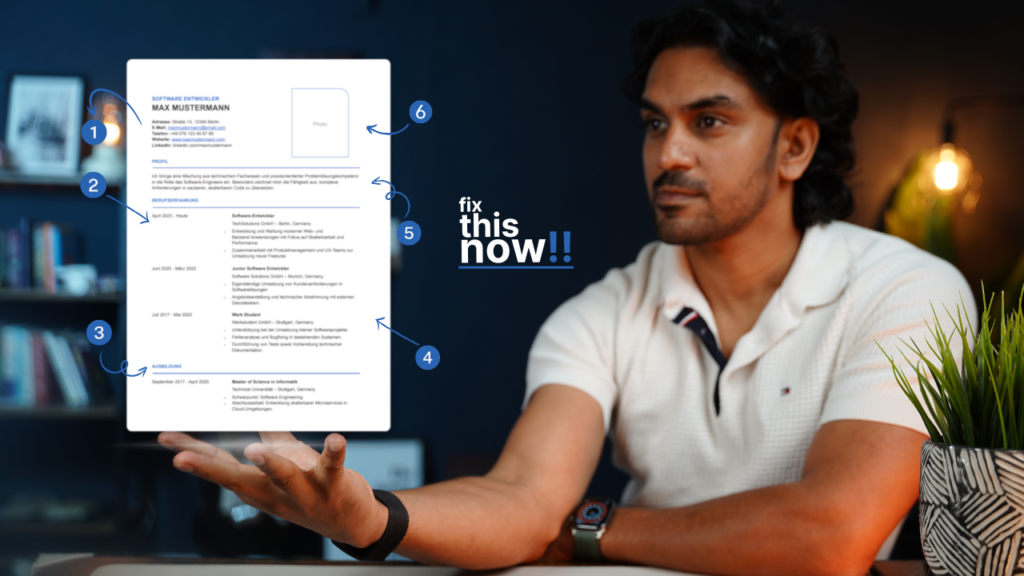
If you’ve been applying for jobs in Germany and not receiving any response whatsoever, it might be time to take a good look at your resume. Because here’s the thing German recruiters expect a very specific format and structure.
And if your resume doesn’t match what they’re used to, your application might not even stand a chance. Doesn’t matter how skilled you are.
I’ll break down exactly what German recruiters are looking for in a resume. I’ll show you the format, the structure, and how to write it the German way. I’ll also share one super simple trick that can instantly make your resume stand out.
What is a German resume?
So, what even is a German resume, or Lebenslauf, as they call it in German? On the surface, it’s not that different from what you’re used to: name, contact details, education, work experience It contains all the usual stuff. But here’s where it gets interesting.
A German resume follows a very specific structure. Let’s start with the formatting.
Format
When it comes to format, there is only one rule: “Keep it simple.” A resume is not a place to show your creativity, unless you are applying to a field that demands it. So no fancy colors, no creative fonts. Use a standard one like Times New Roman or Arial. Set the body text to size 11, and headings somewhere between 14 and 16.
And don’t pack everything too tightly. Leave enough white space in between the content. It should be clean and easy to read.
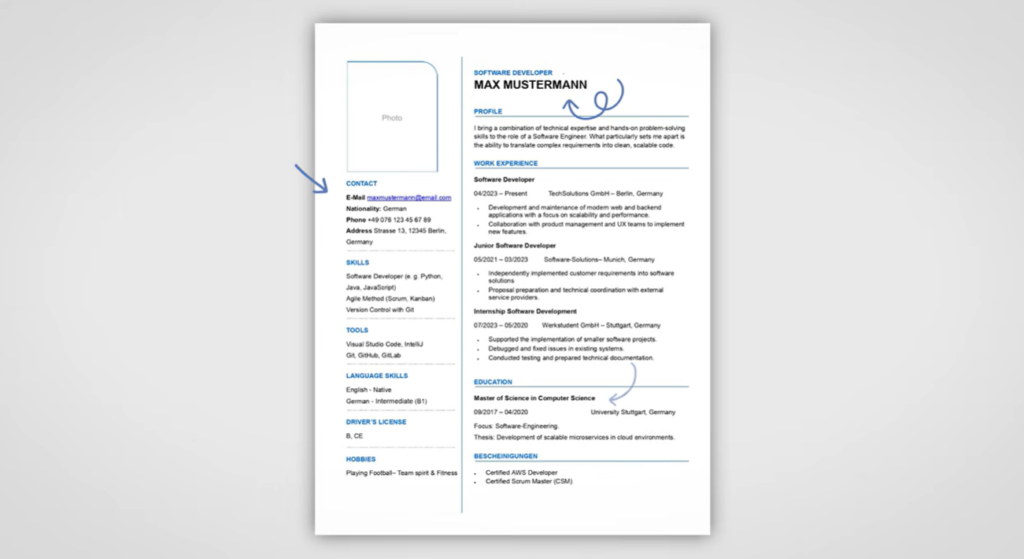
And when it comes to layout, you’ve got two main options here: one-column or two-column.
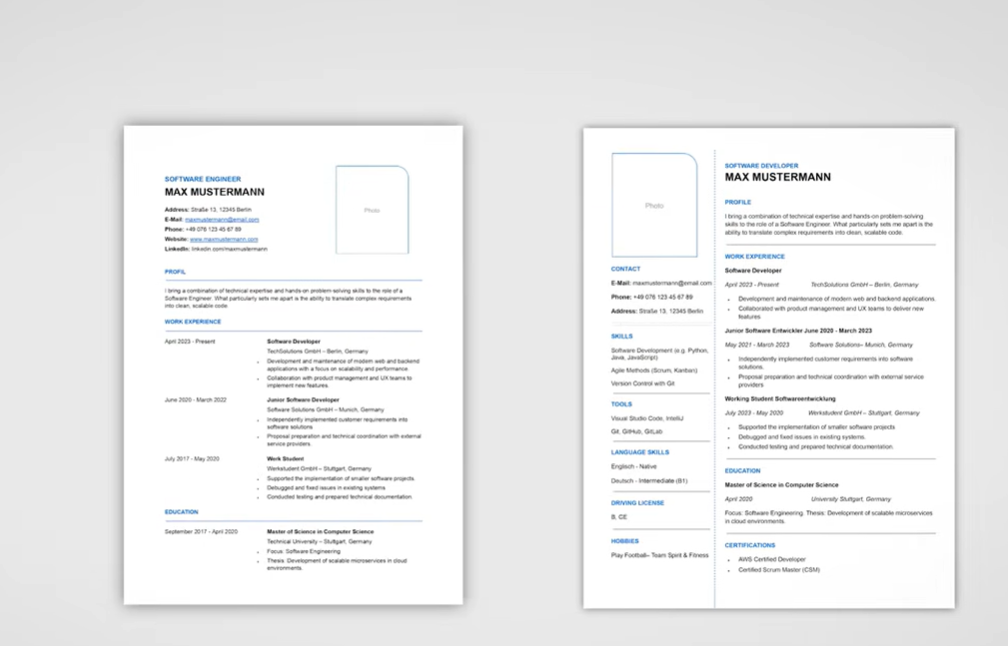
The one-column format is straightforward. It’s good if you’re applying through an online system or job portal, because this format is easier for automated software, such as ATS, to read. But it does take up more space. Compared to that, a two-column layout is more compact.
It lets you fit everything neatly on one page and also looks sharper and more polished. This is more ideal if you’re applying directly to a recruiter or sending your resume by email.
Content
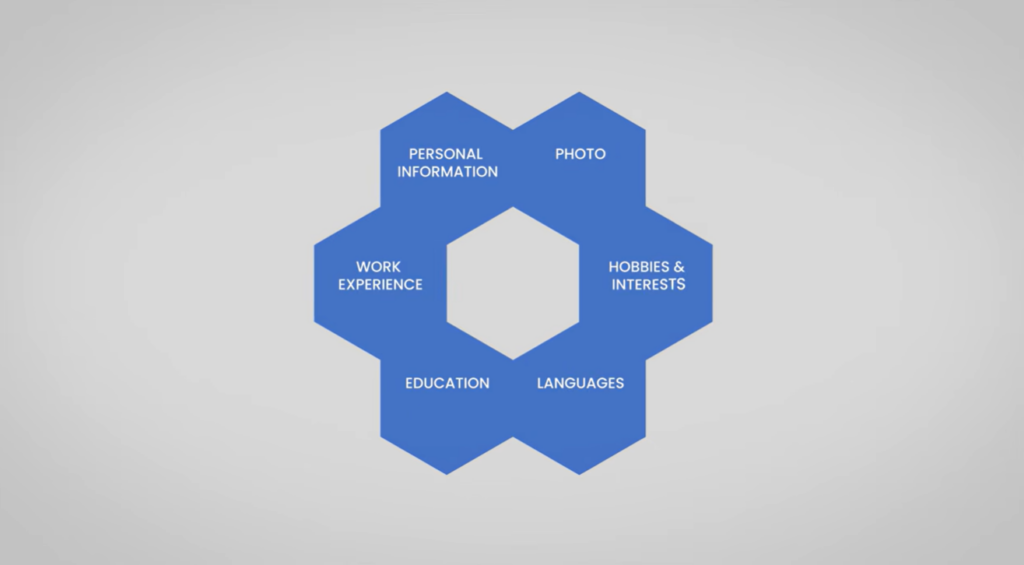
Now, formatting is all about making the first impression. It might get someone to take a look at your resume, but if the content isn’t solid, you’re still not getting that call. Let’s break it down step-by-step.
1. Personal Information
Start with the basics: your full name, email, phone number, and address right at the top. Also in Germany, it’s still pretty common to include the date of birth and nationality. If you want, you can also add 2–3 lines about who you are, right below your contact info. Nothing long, just a quick summary of what you bring to the table.
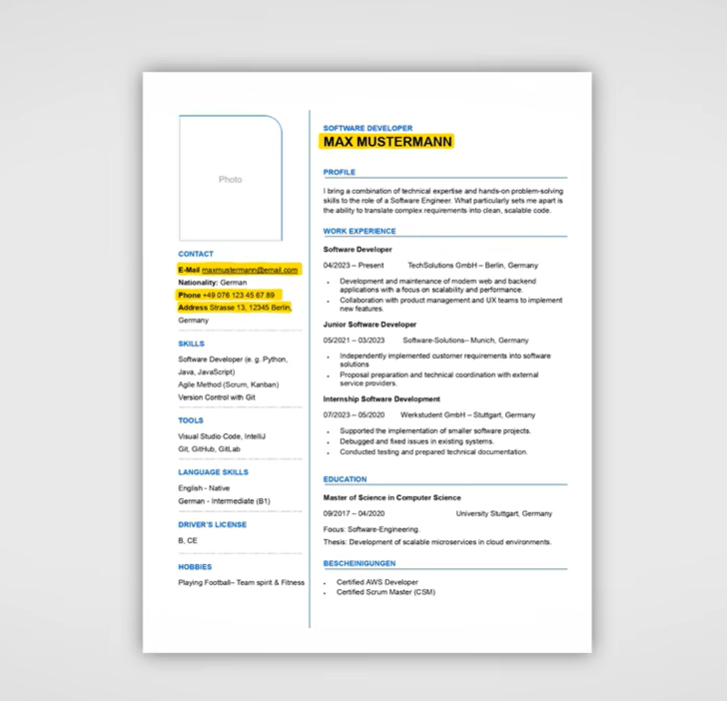
Now, this is a question that I get asked often. Should I write my resume in German or English? And the answer is actually pretty simple. If the job ad is in German and your German is good enough to hold a phone conversation with HR, then go ahead and write your resume in German.
But if you’re not confident with the language yet, stick to English.
2. Work Experience or “Berufserfahrung”
Now comes the most important section. Work Experience. Here, list your jobs in reverse order. So your most recent job goes first, and then you go backwards from there. On the left, write the start and end dates just the month and year; no need for exact days. On the right, put the company name, your job title, and the city.
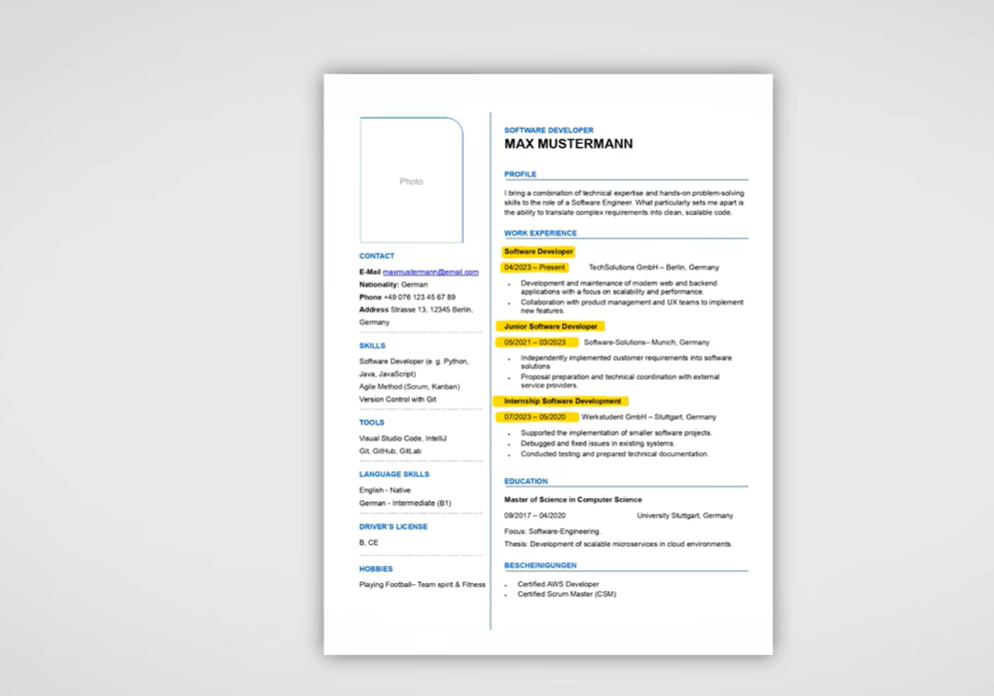
And right below that, add 2 to 4 bullet points describing what you actually did in that role. But here’s the trick: don’t just list tasks. Focus on results. Instead of writing “Managed a team,” say something like “Led a team of 5 and improved project delivery time by 30%.” Use numbers where you can, and be specific.
3. Education
When it comes to your education history, the same rule as before applies: the most recent comes first. Just list your degree, the university name, the location, and the time period. That’s it.
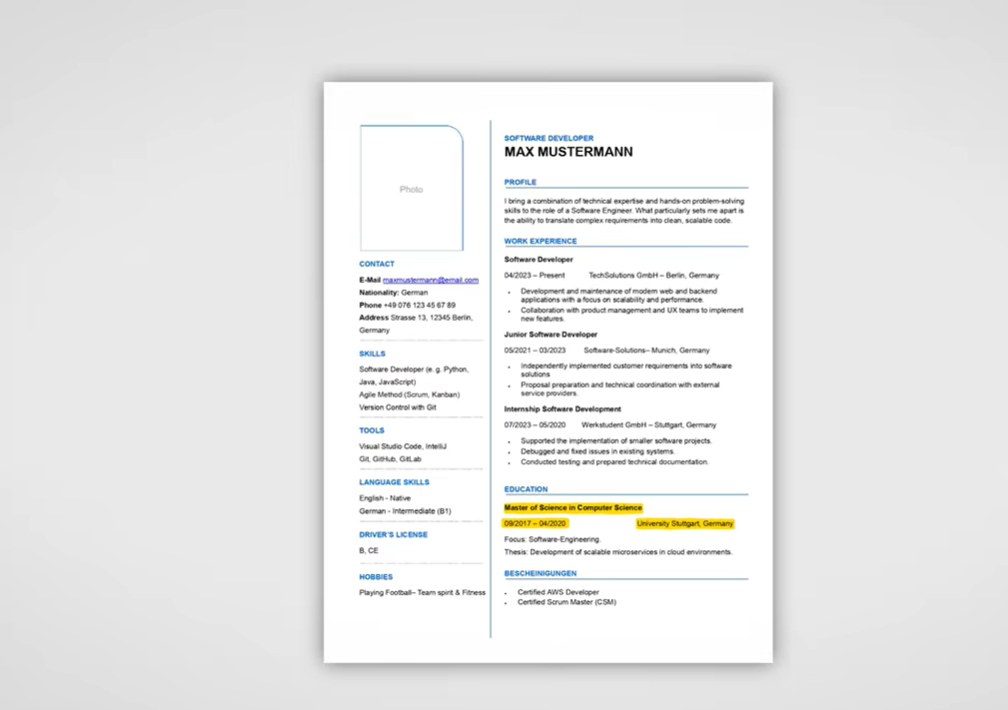
Now, if you’re still a student or just starting out, you can add a couple of relevant courses or maybe a project or two, especially if they’re relevant to the job you’re applying for. But if you already have some decent work experience, keep this short and simple. No need to mention every subject or your GPA.
4. Skills & Certifications
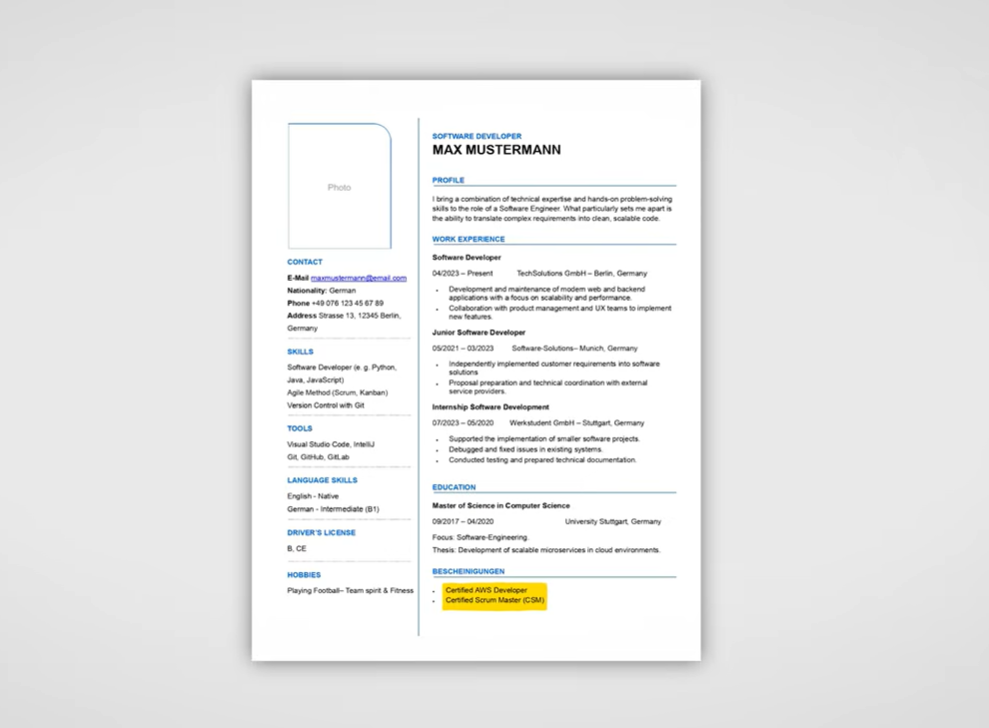
This section is your chance to show what you actually know. So list down your technical skills, software you’re familiar with, tools you’ve used, and anything relevant to the job. If you’ve done any online courses or other certifications, mention them here. Just make sure whatever you include is either relevant or adds real value to the role you’re applying for.
5. Languages
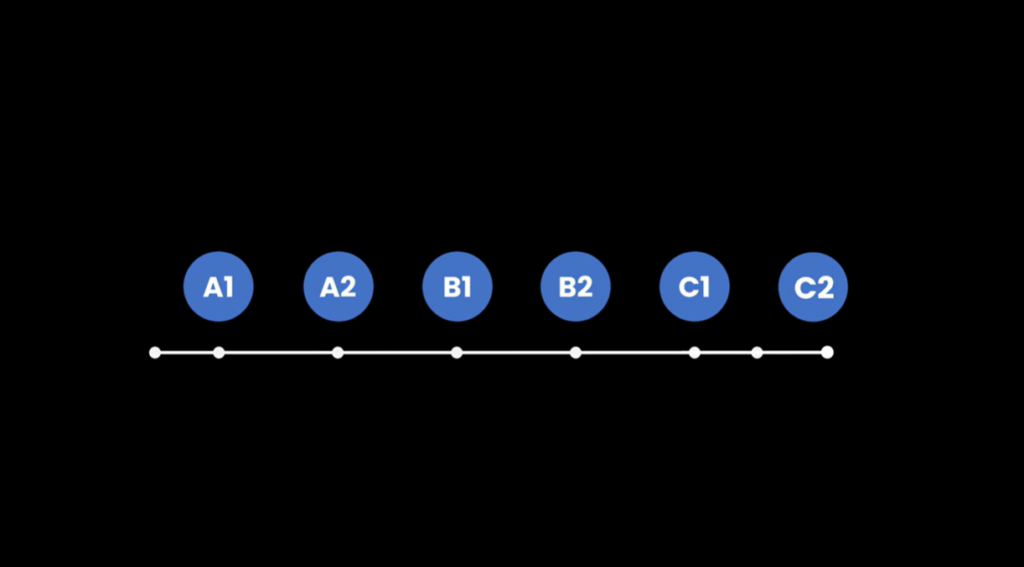
Now, languages. This one’s especially important if you’re applying in Germany. Be clear and honest about your German level. Don’t say things like “good” or “fluent”; instead, use the CEFR scale. That’s A1, A2, B1, B2, and so on. One overall level is enough. You don’t need to break it down into reading, writing, and speaking.
6. Hobbies & Interests
Your hobbies can actually give recruiters a small glimpse into who you are as a person. But here’s the thing: don’t just write “watching movies.” Everyone writes that, and it doesn’t really say much.
Instead, try to pick hobbies that tell them something about you. Like, “I play football weekly to stay active and improve teamwork.” It shows there’s more to you than just your job. But if you can’t think of anything meaningful to add, just skip this part.
7. Photo
Now, a photo is not mandatory, but in Germany, it’s still expected in a lot of companies. Unless the job ad says “no photo,” you’re usually better off including one. A simple headshot with a neutral background and a smile is more than enough.
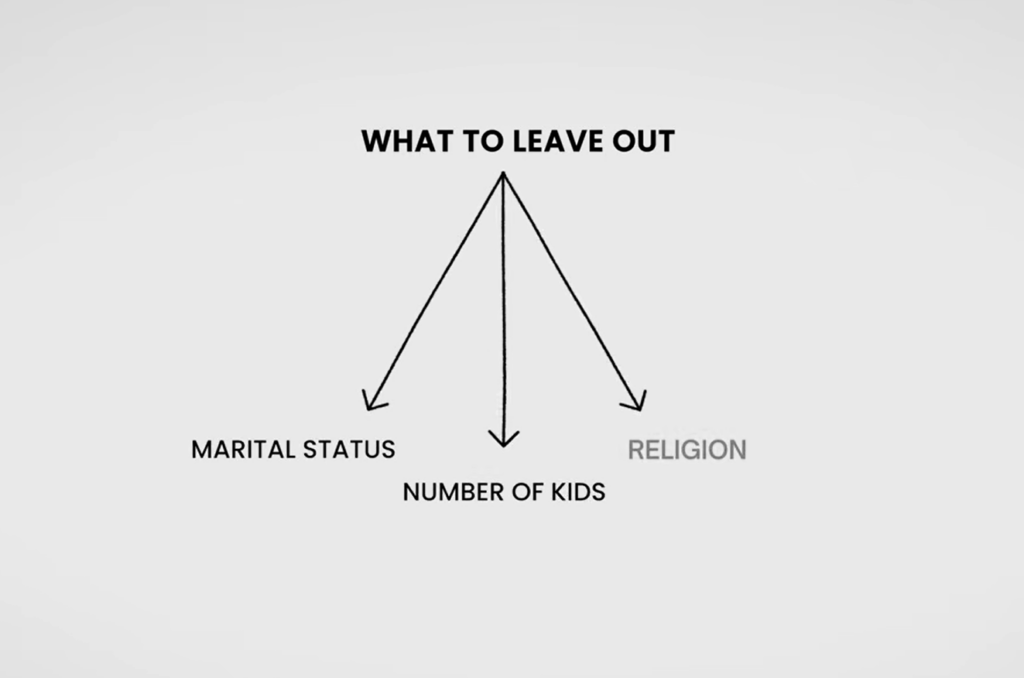
Now, as important as it is to include the right info, let’s quickly talk about what not to include. Don’t add things like your marital status, number of kids, or religion unless the job ad specifically asks for it. In most cases, it’s just not relevant and might even work against you. Also, avoid technical jargon; not every recruiter knows the specific terms you use in your field. And don’t write long stories or chunky paragraphs.
Keep everything short, clear, and to the point. One page is ideal. Two pages max. Anything more, and you’re just making it harder for someone to scan. And finally, this one sounds obvious, but it’s a big one: check grammar and spelling. You’d be surprised how many people get this wrong. So always double-check before you hit send.
Tailor Your Resume
Now let’s talk about the one trick that can seriously boost your chances of getting that interview call: tailoring. Yeah, I get it. Sending the same resume to every company feels easier. Saves time. But here’s the thing: it also makes you look like everyone else. And in a pile of 100 resumes, that’s the last thing you want.
So what do you do instead? Start by actually reading the job ad. Like, properly read it. These job descriptions are full of hints. Look for keywords; they use things like “project coordination,” “Python,” and “client communication.” Whatever they mention often, those are the exact words you want to reflect on your résumé. But don’t just throw them in randomly; use them in context.
Show how your experience or skills align with what they’re asking for. The company is basically telling you what they want in a candidate. You just have to show them that’s you. I know it takes more effort. But trust me, that extra 10 minutes can make all the difference between getting ignored… and getting the call.
And once you’re done, always save your resume in PDF format with a simple filename, something like Firstname_Lastname_Resume.pdf.
So yeah, that’s everything you need to know to build a solid, German-style resume.
Always keep in mind that it’s not about flashy designs or complicated language; it’s about structure, clarity, and showing that you’re the right fit for the job.